07 Applied Hydrogeology
07-07 Freshwater–Saltwater Interaction
Freshwater lenses, Ghyben–Herzberg principle, up-coning, seawater intrusion, sea level rise.
Contents
| Index | Description |
|---|---|
| 07-07-001 | The Ghyben-Herzberg Relation |
| 07-07-002 | Upconing |
07-07-001The Ghyben-Herzberg Relation
| Type: Streamlit app | Time: 5–15 min |
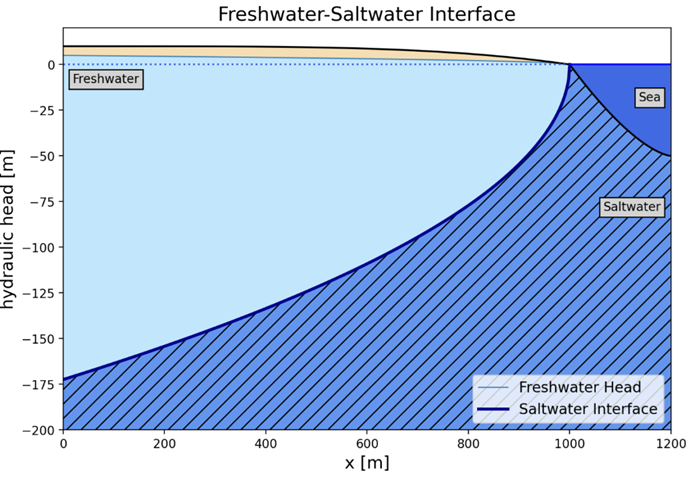
Figure 1: Freshwater-saltwater interface under static hydraulic conditions (Screenshot)
This app illustrates the Ghyben–Herzberg relation for the equilibrium between freshwater and seawater in a coastal aquifer under static (no-flow) conditions. Starting from the classical sharp-interface concept, it visualizes how a relatively small freshwater head above sea level supports a much thicker freshwater body below sea level due to the density contrast between fresh and salt water. Users can interactively adjust the freshwater and saltwater densities as well as the freshwater head at the inland boundary, and immediately see how the position of the freshwater–saltwater interface responds. The cross-section plot distinguishes unsaturated zone, freshwater zone, and underlying saltwater, making the app well suited for teaching the basic physics, assumptions, and limitations of the Ghyben–Herzberg theorem in an intuitive, graphical way.
| Detail | Value |
|---|---|
| URL | ghyben-herzberg.streamlit.a… · open app |
| Author(s) | Markus Giese (University of Gothenburg); Thomas Reimann (TU Dresden) |
| Keywords | seawater, saltwater, interface |
| Fit For | self learning, classroom teaching |
| Prerequisites | None |
Streamlit app details
| Detail | Value |
|---|---|
| Interactive plots | 1 interactive plot(s) |
07-07-002Upconing
| Type: Streamlit app | Time: 5–15 min |
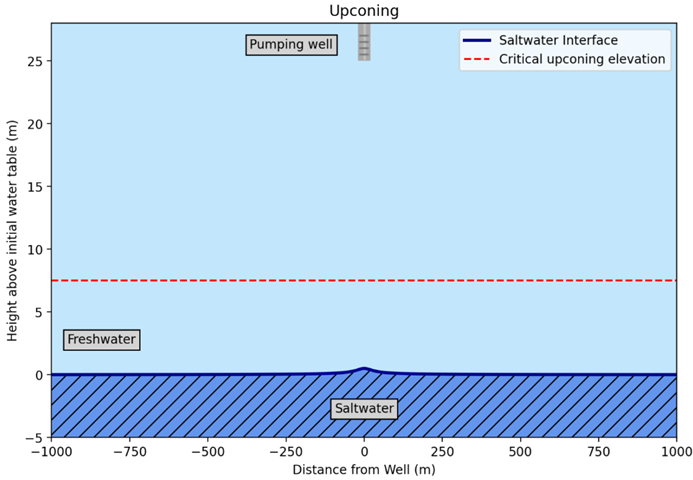
Figure 1: Freshwater-Saltwater interface location in a pumped aquifer (Screenshot)
This app explores upconing of the freshwater–saltwater interface beneath a pumping well in a coastal aquifer. Using a sharp-interface analytical solution, it shows how the interface rises toward the well as you adjust key parameters such as pumping rate, hydraulic conductivity, porosity, density contrast, and pre-pumping distance to the interface. The interactive plot highlights the upconed interface, the maximum upconing at the well, and a critical pumping rate/elevation, helping users understand when pumping remains safe and when the risk of salinisation becomes significant.
| Detail | Value |
|---|---|
| URL | upconing.streamlit.app · open app |
| Author(s) | Markus Giese (University of Gothenburg); Thomas Reimann (TU Dresden) |
| Keywords | seawater, saltwater, interface, pumping |
| Fit For | self learning, classroom teaching |
| Prerequisites | None |
| References | {‘Bear, J. (Ed.), 1999. Seawater intrusion in coastal aquifers’: ‘concepts, methods and practices, Theory and applications of transport in porous media. Kluwer, Dordrecht.’} Callander, P., Lough, H., Steffens, C., 2011. New Zealand Guidelines for the Monitoring and Management of Sea Water Intrusion Risks on Groundwater. Pattle Delamore Partners LTD, New Zealand. {‘Schmork, S., Mercado, A., 1969. Upconing of Fresh Water-Sea Water Interface Below Pumping Wells, Field Study. Water Resources Research 5, 1290–1311. doi’: ‘10.1029/WR005i006p01290’} {‘Dagan, G., Bear, J., 1968. Solving The Problem Of Local Interface Upconing In A Coastal Aquifer By The Method Of Small Perturbations. Journal of Hydraulic Research 6, 15–44. doi’: ‘10.1080/00221686809500218’} |
Streamlit app details
| Detail | Value |
|---|---|
| Interactive plots | 1 interactive plot(s) |