Video Channel
iNUX YouTube Channel – Concept, Purpose, and Use Cases
30 December 2025; v1.0
Markus Giese¹, Roland Barthel¹, Thomas Reimann², Edith Grießer³,
Steffen Birk³, Oriol Bertran⁴, Daniel Fernàndez-Garcia⁴
¹ University of Gothenburg, Department of Earth Sciences
² TU Dresden, Institute for Groundwater Management
³ University of Graz, Department of Earth Sciences, NAWI Graz Geocenter
⁴ Polytechnical University of Catalonia, Department of Civil and Environmental Engineering, Spain
Disclaimer
This document represents a static snapshot of the iNUX YouTube Channel at the time of publication.
The video channel can be reached under:
https://www.youtube.com/@iNUXvideochannelThe most recent online version is available at the gw-inux GitHub repository:
https://github.com/gw-inux/iNUX-Handbook/tree/main/Videos
Content
- Introduction
- Purpose and Design Principles
- Overview, Use, and Technical Implementation
- Acknowledgment
1 Introduction
The iNUX (Interactive Understanding of Groundwater Hydrology and Hydrogeology) YouTube channel supports the project’s objective of fostering an interactive and concept-driven understanding of groundwater hydrology and hydrogeology. Complementing interactive tools, digital assessments, and structured teaching materials, the channel provides short educational videos that visualize essential hydrogeological processes and concepts.
In contrast to conventional lecture recordings, most iNUX videos rely on text-based visualizations rather than spoken narration. This design facilitates straightforward translation into multiple languages and supports use in diverse educational contexts. As a result, the videos can be reused flexibly in international courses, blended-learning settings, and self-paced study formats.
The video collection includes a range of formats, from conceptual animations and visual explanations derived from field courses to screencasts embedded in interactive tutorials and Streamlit-based applications. In this way, the YouTube channel forms an integral part of the broader iNUX learning ecosystem, providing concise visual explanations that complement interactive exploration and hands-on learning activities.
2 Purpose and Design Principles
The iNUX videos are designed to support teaching and learning in groundwater hydrology and hydrogeology by providing concise, visually oriented explanations of key concepts. Their primary purposes are to:
-
introduce or reinforce fundamental hydrogeological concepts,
-
support self-paced and independent learning,
-
complement interactive Streamlit applications and Jupyter-based tutorials,
-
be embedded flexibly in lectures, courses, and digital learning modules.
A design principle of the iNUX video channel is the use of text-based visualizations instead of spoken narration. This approach enables straightforward translation, adaptation to multilingual teaching environments, and reuse across international courses without the need for audio processing or re-recording. As a result, the videos are well suited for both formal academic instruction and open educational contexts.
The channel covers different types of educational videos, including visual material derived from field courses that shows hydrogeological methods, short screencasts illustrating the use of e.g., software for groundwater modeling workflows, and more. Rather than duplicating existing video resources, the iNUX videos focus on content that directly supports the project’s interactive tools and teaching concepts. Overall, the videos follow the same guiding principles as the broader iNUX learning ecosystem: clarity, accessibility, conceptual accuracy, and reusability.
3 Overview, Use, and Technical Implementation
The iNUX videos are primarily used as supporting learning elements within a broader teaching and learning workflow. Their technical simplicity allows them to be integrated into different educational contexts with minimal effort.
In lecture-based teaching, the videos are typically used as short introductions or targeted clarifications of specific topics. They can be embedded directly into presentation slides or accessed via links during class to support discussion and conceptual explanation. Within interactive Streamlit applications and Jupyter-based tutorials, videos are used to prepare learners for hands-on interaction, providing a concise visual overview before users explore models, simulations, or exercises.
The videos are also used beyond the classroom. Students can access them independently to review key concepts, prepare for exercises or assessments, or revisit material after field courses. In field-based teaching, selected videos serve as preparatory material or as follow-up resources to help contextualize observations made on site.
From a technical perspective, the videos are hosted on YouTube and can be embedded or linked across platforms without additional software requirements. Their silent, text-based format enables straightforward reuse in different teaching environments and supports integration into web-based tools and open educational platforms.
Figure 1 illustrates two representative examples from the channel. These videos demonstrate typical hydrogeological field activities and can be directly embedded into interactive learning environments. Each video is accessible via a direct link and can be reused independently or in combination with other iNUX materials.
Example videos (Figure 1)
Left: measuring groundwater heads
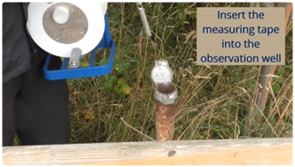
Video link: https://www.youtube.com/watch?v=FFo5jfkIM5c
Right: performing a slug test
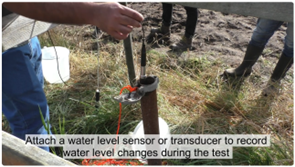
Video link: https://www.youtube.com/watch?v=McAUe3cOYKs
Figure 1: Two example videos from the iNUX YouTube channel (clickable links). Left: measuring groundwater heads. Right: performing a slug test.
The iNUX YouTube channel comprises a growing collection of short educational videos that support different teaching and learning contexts within groundwater hydrology and hydrogeology. The iNUX video channel is available under:
🠚 https://www.youtube.com/@iNUXvideochannel
In addition to standalone use, videos are explicitly integrated into Streamlit-based applications, where they serve as concise introductions or guided explanations within a broader interactive workflow, e.g., in the Streamlit app about Slugtest evaluation (https://slugtest-multilingual.streamlit.app/; Figure 2).
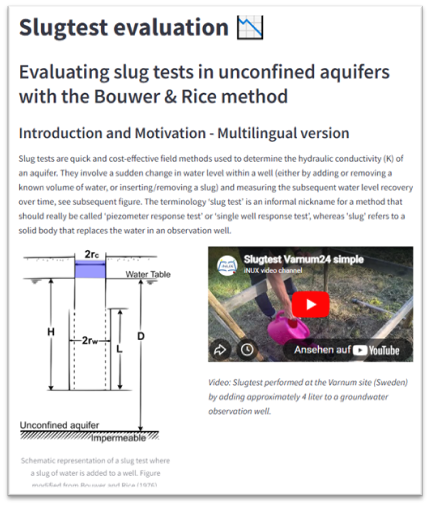
Figure 2: The Streamlit app about Slugtest evaluation embeds a video from the iNUX YouTube channel.
In addition to the publicly visible videos, the iNUX YouTube channel also hosts a set of screencast videos that form the basis of several Streamlit-based tutorials, as illustrated in Table 1. These screencasts are intended to guide users through specific workflows, such as numerical modeling and postprocessing tasks, and are accessed primarily through their integration into the corresponding interactive applications. While technically hosted on the iNUX YouTube channel, these screencast videos are not listed publicly on the channel and are instead made available contextually within the associated Streamlit tutorials. Table 1 provides an example illustrating how screencasts are embedded in a Streamlit app to support numerical modeling and interpretation tasks.
Table 1: Example of a Streamlit application making use of iNUX screencasts
| Name | Link | Video implementation |
|---|---|---|
| Modflow-2005/MODELMUSE Tutorial: 2D Steady State Groundwater Flow for a Synthetic Catchment | https://modflow-tutorial-2d-synthetic.streamlit.app/ | 5 videos showing the basic steps in groundwater modeling with the software MODELMUSE |
| Tutorial: Numerical model of a pumping test | https://modflow-tutorial-2d-theis.streamlit.app/ | 7 videos showing the different steps and methods to setup, run, and evaluate a numerical groundwater model |
| Tutorial – Numerical computation of solute transport: Demonstration of MT3D applications | https://mt3d-tutorial-2d-synthetic.streamlit.app/ | 8 videos that show different steps in the workflow, embedded in a complete Streamlit app with additional assessments and interactive plots |